Traditional, low-code and no-code development: everything you need to know
Discover the different tools available for modern web development, their key differences, and which might be the best option for creating your website today. At Dei-Tec, we offer guidance to help you choose the best development process based on your budget and timeline. Thanks to the various technologies available, we'll propose solutions tailored to your needs, so you can decide which option best suits your project.
Keiver Miranda
Development

Introduction
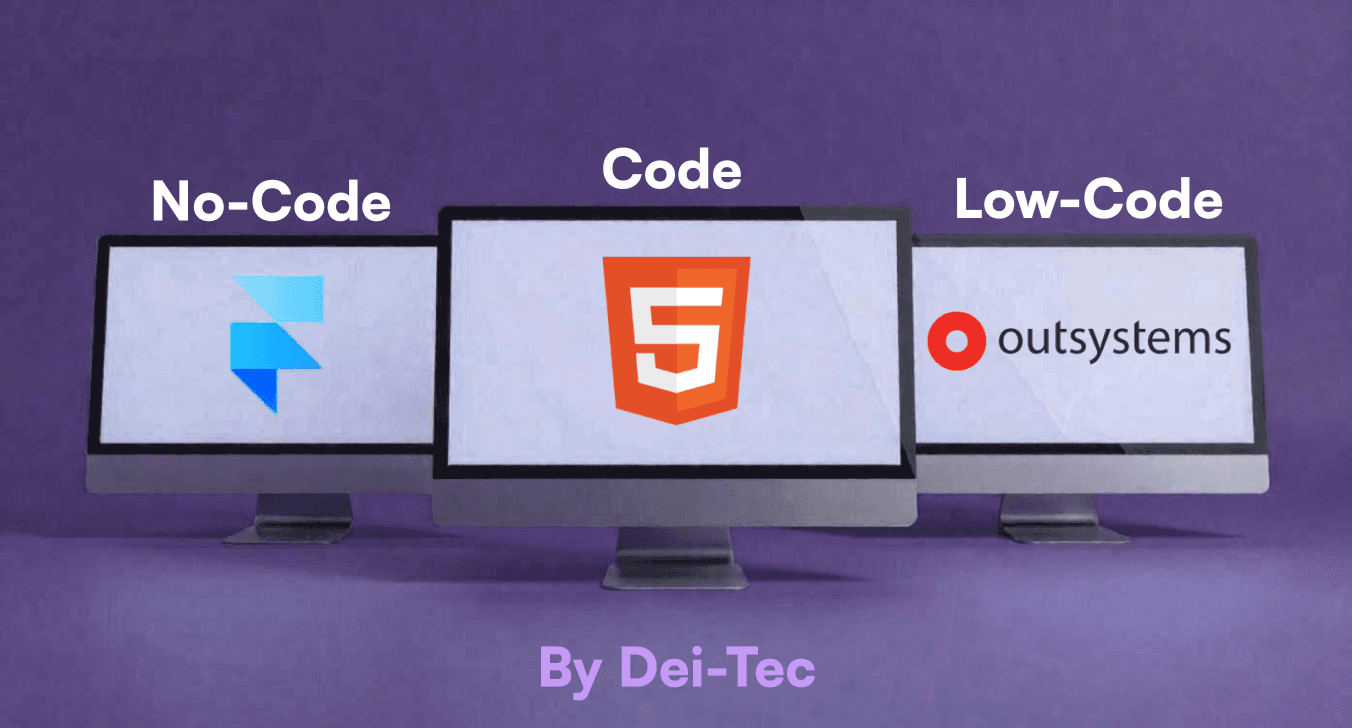
Today, there are three main approaches to creating a website. The first is traditional development using code, which involves building web platforms by writing code from scratch and offers a high level of customization. The second approach is visual or low-code platforms, which allow for faster website development thanks to graphical tools and pre-configured components. Finally, there are no-code platforms, where no programming is required, making them the simplest option for those with little or no web development experience.
A summary of each approach follows.
Code
This is the traditional method of creating websites and the most widely used to this day. This approach offers greater freedom in designing the page and defining the desired functionalities, allowing for a high level of customization and control over the website.
Advantages
Greater scalability
Having complete control over the website's functionalities makes it easier to expand and improve the platform. Mastering the code allows for the simpler addition of new features, adapting the site to the project's growth and future needs.
Total system control
Having access to the website's source code allows the developer to access all the application's functionalities, modify them according to the project's needs, and correct any errors that may arise, enabling greater control and flexibility in development.
Disadvantages
Greater investment of time
When developing a website from scratch, it is necessary to build both the visual part and all the functionalities of the application, which implies a longer process compared to other web creation platforms.
Advanced programming skills
When developing a website entirely with code, it is necessary to properly understand the languages used and have a solid level of programming to be able to build and maintain all the functionalities of the platform.
Some of the most commonly used tools for this method are:
HTML
CSS
JavaScript
Java
Python
TypeScript
Low-Code
This approach still requires some programming knowledge, as some specific functions need code for their implementation. However, many parts of the application can be developed without programming from scratch, making this method faster and more accessible. For this reason, low-code platforms have gained popularity among developers and businesses.
Advantages
Less need for programming knowledge
This approach does not require as high a level of programming knowledge as developing from scratch, since the platforms that use it include predefined tools and components that allow you to create a website without building each functionality manually.
Good speed for MVP development
Low-code platforms offer a wide variety of tools that facilitate the creation of MVPs (minimum viable products), as they allow for simpler website development compared to building from scratch. This significantly accelerates the development process and allows end users to view and test the application in less time.
Disadvantages
Platform dependency
Because the application relies on a platform to function, development options are limited to the tools and features that platform offers. Furthermore, if the platform experiences failures or becomes unavailable, the application may also be affected or even become unusable, as its operation depends directly on it.
More expensive scalability
When creating a website using a low-code platform, scalability depends directly on the services it offers. Many platforms include free tools initially, but as the project grows, they often begin charging for advanced features, which can increase the investment needed to meet the evolving needs of the end user.
OutSystems
Mendix
Microsoft Power Apps
No-Code
This is one of the simplest methods for creating websites today, as it doesn't require any technical programming knowledge to develop a page. Thanks to these platforms, designers, entrepreneurs, or people starting a project can quickly create their business website without needing to hire a developer or learn advanced programming to achieve results.
Advantages
Faster website creation
With multiple templates and the ability to create pages simply by dragging and arranging components, this approach becomes one of the fastest ways to develop a website or application today.
Suitable for all audiences
Since no programming knowledge is required, anyone can start creating an app or website using these platforms. All you need is a clear idea of what you want to develop, and thanks to the various templates available, you can easily turn that idea into reality.
Disadvantages
Technical limitations
On these types of platforms, the functionalities depend entirely on what the tool offers. While they allow for the quick creation of websites or applications, they can be limiting when a project requires more advanced logic, as some ideas cannot always be implemented with the tools they provide.
Limited scalability
This method is ideal for small projects, prototypes, or MVPs, but as an application grows in users, data, or complexity, performance and cost-related difficulties can arise. Many of these platforms are not configured to handle high-traffic systems.
WebFlow
Framer
Bubble
Conclusion
Choosing a development method depends on several factors, such as programming skills, available budget, and the timeframe for application completion. Each development approach is more suitable in certain contexts, which becomes clear when analyzing their respective advantages and disadvantages.
Programming offers maximum control, customization, and scalability, making it perfect for more complex projects or those requiring specific features. Low-code platforms, on the other hand, offer a balance between speed and adaptability, enabling faster application development without completely sacrificing customization. In conclusion, no-code development is characterized by its simplicity and speed of implementation, making it an ideal option for entrepreneurs, prototypes, or projects requiring a rapid market launch.
In short, there is no single ideal method that applies to all cases. It is essential to evaluate the project's objectives, anticipated growth, and available resources to select the option that best suits each circumstance and allows for the creation of an effective and sustainable website.